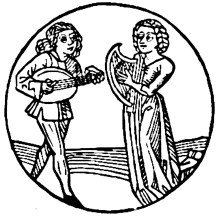
The Pennards were a taut, riff-driven, mod-rock, fop-pop, beat combo who enjoyed large-scale but short-lived success in the Crawley area of Surrey between the unusually warm autumn of ’64 and the not especially hot summer of ’66. Fronted by self-styled poet Quentin Penn and flanked by even-fisted brothers Gary and Andy Hardwick they first burst onto the live circuit as The Pennwicks – a trio in which the enthusiastically fast strumming of acoustic guitars provided backing for Penn’s meandering melodies.
Distinctly folky in style and with Penn’s tendency to introduce his songs as ‘laments’ they became known briefly as The Lamentables. As Gary and Andy’s strumming got faster and faster, both in a bid to outplay each other and to bring Penn’s tiresomely long lyrics to a quick conclusion, they renamed themselves The Sonnets, then The Modern Sonnets and finally (with the addition of rhythm section Gig Chipper and Roger Blunt) Modern Sonnet with a Rhyming Couplet. The arrival of Blunt and Chipper gave the group a steady edge and a solid foundation on which to build. They were soon in search of a new sound and, more importantly, a new name.
Roofers by trade the Hardwick brothers had first earned a reputation as a combustive double act, their sets generally ending when the pair began brawling with audience members. When there was no audience (and generally there was no audience) they fought with each other. These were turbulent times in the Surrey-Sussex boarders; the Summer of Love was some years off and the spectre of the Pease Pottage Teds, a fearlessly Brylcreamed gang, appeared to threaten the tranquillity of villages all the way from Colgate to Crawley Down. The Hardwicks provided the soundtrack to this menace until a bobby on his bicycle moved them all on.
Penn’s arrival brought a unity to the squabbling duo. It was not so much his calming influence, more that he became a focus, a channel for the pair’s rage; they could now direct all their hate at him rather than at each other. With a drummer and bass player in place, the fresh blood provided the brothers with further targets for their vitriol. The stage was set. Things moved at a pace and, musically, the band quickly ran out of ideas. Undaunted, they turned their attention to their image, opening up entirely new avenues for disagreement and exciting new routes for argument; the possibility for fall-out seemed endless.
As Penn’s hair grew longer, Gary’s trousers got tighter and Andy’s temper got shorter. The band were at their height and London was in their sights. But cracks were already beginning to show. At a gentlemen’s outfitters, one Saturday afternoon in Redhill Andy picked out a lime green shirt and a puce silk tie. Gary looked up but said nothing. “The spark had gone” Andy would later confide. “Gary hated puce with a passion and yet he just let it go. I knew then that it was over.”
Quentin Penn was the first to quit even though the band, now spiralling into heavy dependence on new clothing lines and found more frequently in the department stores of Dorking than in their Horley studio, failed to notice for six months. His new group, Iambic Pentameter, may have given him more room to experiment with poetry but it lacked the tension and thankfully quick endings that the Hardwick brothers had always brought. Gig Chipper and Roger Blunt would go on to open their own clothing emporium in East Grinstead. It closed in 1976.
Vile traitor of love’s hypocrisy
stand down in vermilion
curse my wretched flesh
and its soft weakness
too much I have supped
from southern buds
my longing for thee
is as the owl to the moon
or the fox to his lusty hole
From ‘Arcadian Repose Nº 9’ The Seraphim Sings and Other Poesy by Quentin Penn
 Albion Parade