A Journey to the Heart of English folk music (changing at London Bridge)
I took the morning train to Bedford, birthplace of Vic Briggs and home to Bedford museum, where Briggs’ trademark instrument, the boghorn, was rumoured to have once resided. As we rattled gently through the English countryside I took the time to recall what I already knew about the man and his fabled instrument.
As an impressionable 16 year-old in thrall to the late Sixties English Folk scene, I had found myself working as a roadie for the soon to be legendary Albion Parade. As such, I had carried Vic Briggs’ boghorn case many times but had only seen the instrument itself fleetingly.
Briggs’ was notoriously secretive about his creation, convinced that it would be copied by anyone who saw it and, when performing live, would play with his back to the audience, shrouded in what seemed to be a large, unzipped sleeping bag. It was my job and my job alone to carry it to and from the van. He would pack, unpack and maintain the boghorn himself, often spending long hours alone, lovingly greasing it’s pig-knuckle valves with duck fat. As for the case, well, the case I knew very well.
Strong and durable, it was of a common plywood construction upholstered in some kind of haired animal skin, possibly horse or goat. This skin had been crudely and violently branded with Brigg’s initials though whether this had been done before or after the beasts demise was hard to ascertain.* Scrumpy-stained and infused with woodsmoke, the case seemed to have taken on the spirit of every Steam Fayre and Country Show that it had briefly called home. At times it felt like I was carrying history; a daunting prospect for a 16 year-old boy, though the generously padded handle certainly eased this imagined burden.
Only once did I see the actual boghorn, glimpsing it, in a moment of stolen pleasure, through an open studio door. And though the intervening years have blurred the memory, even back then it seemed vague and unknowable. A compendium of contradictions, it’s form was monstrously elegant, both sinuous and angular and I gazed upon it in wonder for a full five seconds before Briggs slammed the door in my face.
Luckily, through archive interviews and Briggs’ own diaries, we have some idea of the boghorn’s construction. The main body was carved from a single piece of bog-aged hazel-wood, attached to which were a series of small ‘air-sacs’ or ‘wind-pouches’, fashioned from horse stomach and squeezed by the elbow to produce the lower tones. Alongside these sat a row of pig-knuckle valves on which the melody was played.

When it came to the mouthpiece, Briggs tried out a variety of beaks, experimenting with mallard and swan before finally settling on coot. This was sanded and varnished before fitting and was slightly offset with the lower part protruding past the upper (imagine the coot with an underbite).
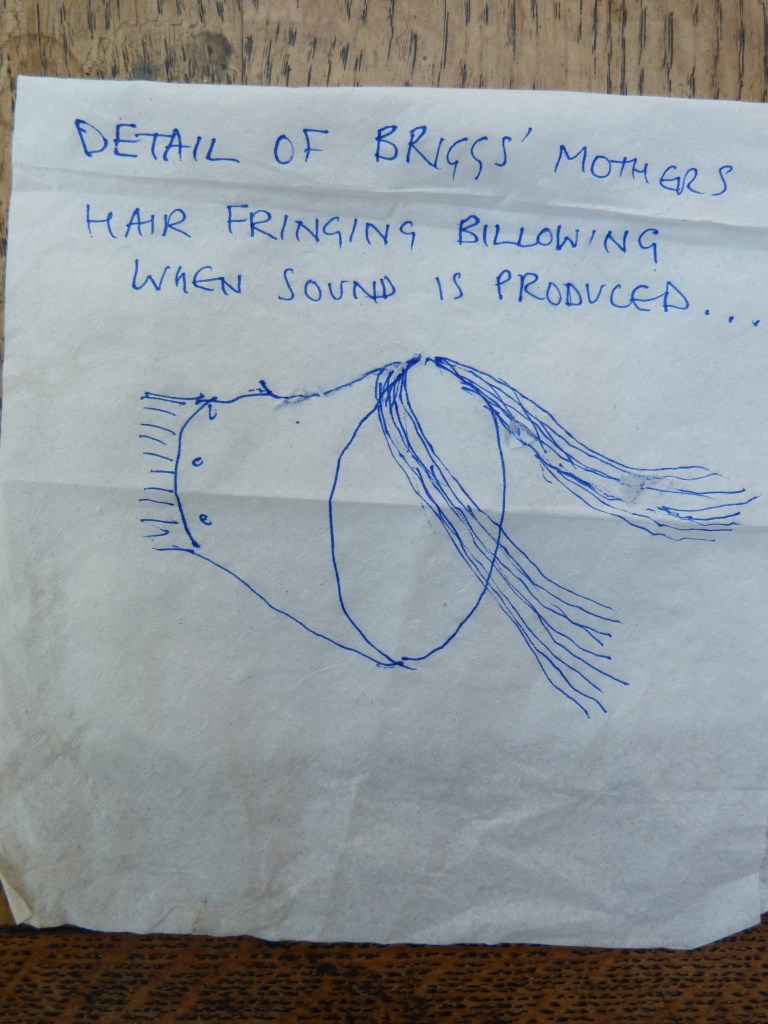
At the other end of the instrument was the flared bell made of hammered tin which, for decorative purposes, was fringed with human hair (probably belonging to Briggs’ late mother) which would billow gently when the sound was produced.
And what a sound it was. Described by Briggs’ himself as ‘somewhere between a cry for help and the indifferent ‘pah’ of a Frenchman’, the call of the boghorn was as contradictory as it’s physical form. Bullishly deferential, intrusive yet reserved, it seemed to embody something at the very heart of English folk music.
I was shaken from my musings by our arrival at Bedford. Leaving the station and walking through streets that had once echoed with the shuffling of Briggs’ battered sandals**, I arrived at the museum.
I directed my enquiries to a young man at reception who told me that my best bet would be to speak to Laura, one of the curators, who might be able to help. Laura was duly summoned and I asked her if the museum had any information regarding Vic Briggs’ boghorn and Bedford’s rich folk music history. Looking a little confused, Laura said that she had no idea who Vic Briggs was and that I really should have phoned first and saved myself a journey. She went on to say that they did have a comprehensive section on Bedford’s pre-Roman history, focusing on some Bronze Age settlements that had been found in the town. Maybe I’d be interested in that? I politely declined and gently insisted that perhaps a quick check on the museum’s computer system might shed some light. This was undertaken, with some slight but noticeable reluctance on her part, but with depressing inevitability , her efforts drew a blank. Tiring of the phrase ‘you really should’ve phoned ahead’, I pressed her again on whether the name rang any bells. She thought for a moment but the best she could come up with was an Ian Briggs, a local builder who had once helped her dad erect a carport. As far as she knew, he had no interest in folk music and had certainly never built his own instrument.
Bidding Laura a cursory farewell, I felt that I somehow knew less than I had when I’d arrived. But as I gathered up my things to leave it struck me that, in many ways, this was a fitting conclusion. The mystique remained intact; the myth untarnished. Stopping at the toilet on my way out, to answer a call of nature, I sat in the cubicle and reflected on my day.
As I glanced over the childish and profane graffiti scrawled onto the inside of the toilet door, one particularly foul obscenity caught my eye. Daubed in what I hoped was smudged black marker, was there something in the curve of that ‘B’ that brought to mind Vic Briggs’ initials burned into the skin of the boghorn case? Had Briggs visited the museum as a young boy and, like me, found his visit a complete waste of time? Had his pale, youthful buttocks once perched on this very seat as he vented his anger on the cubicles’ Formica surface? It was a tantalising prospect but, like so much about the great man, one could only guess….
Andy Blackwell
* Briggs also initialled everything he owned with a black permanent marker. He had a second pen with which he initialled the first. This ‘back-up pen’ was presumably initialled with the main one.
** Worn out, rather than dipped and deep-fried.
 Albion Parade